
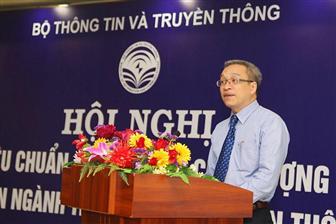
Vietnam
has a population of near 100 million and there are over 70 million handset and
Internet users, providing a good foundation for stable development of the
country's information and communications technology (ICT) industry, according
to a deputy minister of Vietnam's Ministry of Information and Communications
(MIC).
MIC statistics show that Vietnam's aggregate ICT industry
production value amounted to US$91.59 billion in 2017, shooting up 35.3% from
US$67.69 billion in 2016, with the growth numbers indicating a booming
development of the country's electronics industry. Samsung Electronics' handset
production base in Vietnam has been the major source of Vietnam's ICT exports,
but the company has just unveiled its plant in India and is also likely to face
growing competition. This has prompted Vietnam to show much interest in
diversifying industrial production and cultivating tech startups.
Vietnam customs statistics also indicate that the
country's exports of diverse electronics hardware devices including handsets
came to US$81.60 billion in 2017, representing a sharp annual increase of 38%,
much higher than the corresponding growth of 11% registered in 2016. Of the
total exports, handsets commanded US$45.27 billion, up 13.2% on year; and
exports of computers and peripherals soared 36.8% on year to US$26 billion.
These electronics products alone had contributed a trade surplus of over US$20
billion in 2017.
More investments in IC design, 5G
The minister is well aware that Vietnam can hardly
develop a solid footing in the market should its technologies fail to catch up
with international standards. At the moment, Vietnam's electronics industry
highly relies on export trade and contribution by Samsung. And therefore the
MIC hopes for more investments in the development of IC design and 5G technologies
to enhance industry diversity, and also shows great concerns about whether
smart city applications can bring more opportunities for local industries.
On another front, MIC estimates the total annual
production value of Vietnam's software industry at US$3.8 billion for 2017, up
24% from 2016. In terms of ICT applications, 60% of elementary schools and 80%
of middle schools have provided computer and online teaching programs; all
commercial banks have offered electronic payment services, and 96% of financial
transactions can be done online, and mobile banking penetration rate stands at
34.5% while up to 99% of enterprises can pay taxes via electronic channels.
Vietnam's information service industry had managed to
maintain a high annual export growth of 30-40% during 2013-2017 while also keen
to provide business process outsourcing (BPO) services for software programs,
with Japan being the largest export outlet and service recipient. Vietnam is
now Japan's second-largest supplier of information services and also a favorite
partner for Japanese enterprises. In recent years, Vietnam has been active in
developing digital content and gaming industries, with the 2017 production
value of the former rising 8% on year to US$800 million and the latter surging 27%
to US$370 million.
Talent grooming
Talent is fundamental to ICT development. Vietnam now has
a total of 250 universities and colleges, able to foster over 50,000 ICT
personnel per year. The country's ICT sector now has around 900,000 employees,
with the number increasing at an annual rate of 7-10%. Statistics show that the
starting monthly pay for ICT employees in Vietnam now averages US$288, and
their annual incomes average US$7,000.
Now in Vietnam, young people command a high portion of
its population, and more young people are moving to urban areas, providing a
major advantage for ICT development in the country. Vietnam will not rule out
ICT talent exchanges with foreign countries, to allow its new generation to
experience the latest tech and industry developments.
The minister pointed out that along with stable economic
development in Vietnam, many business sectors have produced many successful
private enterprises. However, this is not the case with the ICT sector, which
has not seen many successful private firms. Vietnam holds Taiwan's ICT industry in high regard and is willing to learn from
Taiwan about how to inspire the private sector to foray into the ICT industry.
Source: Digitimes
About us: TMA Solutions was established in 1997 to provide
quality software
outsourcing services to leading companies worldwide. We are one of
the largest software outsourcing companies in Vietnam with 2,600 engineers.
Visit us at https://www.tmasolutions.com/


No comments:
Post a Comment